Smart Cities and Sustainable Mobility
Green Transit: How the Cities of the…

Rome will host the Eco Festival of Sustainable Mobility and Smart Cities on September 15–16, 2026.
On September 15 and 16, 2026, Rome will host the Eco Festival of Sustainable Mobility and Smart Cities, uniting institutions, industry leaders, researchers, and citizens around a vital question: how do we want to move and live in the cities of tomorrow? For Foreste per Sempre OdV, this event represents a crucial platform to demonstrate that sustainable mobility extends far beyond engines and infrastructure—it is fundamentally tied to urban green spaces, air quality, and the overall health of our city ecosystems.
Sustainable mobility refers to a transportation model designed to meet the travel needs of people and goods while minimizing negative environmental, social, and economic impacts. Ultimately, the objective is to ensure that modern transport systems align with society’s current and long-term needs, all without depleting vital resources or compromising the quality of life for future generations.
This requires championing low-impact transport—such as bicycles, electric mobility, and public transit—while redesigning urban spaces to minimize travel distances and reliance on motorized vehicles. Furthermore, it involves seamlessly integrating transportation networks with broader urban initiatives, spanning from the expansion of public green spaces to the improvement of air quality.
Sustainable mobility is not an isolated issue: it is an integral part of the broader concept of the smart city. Smart cities aim to develop services and policies that improve quality of life, inclusion, and urban resilience. A city that invests in clean and accessible transportation is, in fact, also investing in public health, social equity, and the ability to adapt to climate shocks and emergencies.
Imagine a city where public transit is both seamless and comprehensive, dedicated cycle lanes bridge the gap between downtown and outlying neighborhoods, and real-time updates on traffic and air quality are universally accessible. Such an urban center is inherently more inclusive—tearing down mobility barriers for non-car owners—and vastly more resilient, dispersing commuter traffic across a diversified network rather than relying on a single point of failure.
Sustainable mobility discussions often overlook a critical element that profoundly shapes our urban landscapes: physical space. The average private car remains parked and unused for the vast majority of its existence, sitting idle at home, near workplaces, or outside shops. It occupies valuable public land for hours or days while serving its purpose for only a fraction of that time. When multiplied by hundreds of thousands of vehicles, this inefficiency transforms entire neighborhoods into areas designed for cars rather than people. The result is an urban fabric defined by oversized streets, vast surface parking lots, and stopping zones that disrupt the flow and continuity of sidewalks and public spaces.
True sustainable mobility—powered by efficient public transport, car and bike sharing, and active travel—drastically reduces the number of private vehicles required to meet urban travel demands. Fewer cars on the road and parked along our streets not only alleviates traffic congestion, but more importantly, creates a vital opportunity to reclaim vast expanses of concrete and asphalt, returning valuable land to the city and its people.
This reclaimed urban territory is far from a marginal detail; it represents the core objective of modern city transformation. Every square meter reclaimed from redundant parking or superfluous lanes holds the potential to evolve into an expansive sidewalk, a dedicated bike path, a vibrant public square, an urban garden, or, most importantly, a lush green sanctuary. Minimizing impermeable surfaces and cutting back on asphalt directly mitigates urban heat islands—those dense zones where trapped solar radiation causes summer temperatures to soar far above those of surrounding green spaces. Replacing these heat-absorbing dark surfaces with a canopy of trees, verdant lawns, and thriving gardens stands as one of the most powerful strategies for cooling our cities and enhancing livability during the hottest months of the year.
With this in mind, sustainable mobility is much more than an alternative way to travel—it serves as a powerful catalyst for urban regeneration. Every redundant parking space and every lane narrowed to make way for a bike path represents a tangible opportunity to expand public green spaces, ranging from community gardens to micro-forests. This transformation reclaims livable environments for citizens, replacing asphalt and sheet metal with nature and community.
A cornerstone of this evolution is the circular economy, which champions reuse, recycling, waste minimization, and sustainable models of production and consumption. Within mobility, this translates to engineering vehicles and infrastructure with their eventual end-of-life factored in from conception—featuring fully recyclable batteries, reclaimed materials, and shared transit models like car- and bike-sharing that drastically lower the vehicle count required to fulfill community travel needs.
Transforming urban centers into efficient, sustainable, and future-proof environments demands a holistic approach where technology, governance, and strategy converge. Deploying a new electric fleet, for instance, falls short without supportive incentive structures, a robust charging infrastructure, and public-private coordination. Consequently, achieving the ecological transition in urban mobility is a collaborative endeavor that relies just as heavily on institutional innovation as it does on technological advancement.
This is precisely where the mission of Foreste per Sempre OdV intersects with the core themes of the festival. Urban regeneration and reforestation—manifested through expanding green spaces, revitalizing neglected city areas, and implementing vital climate change solutions—are not simply aesthetic additions to sustainable mobility; they are its indispensable counterpart.
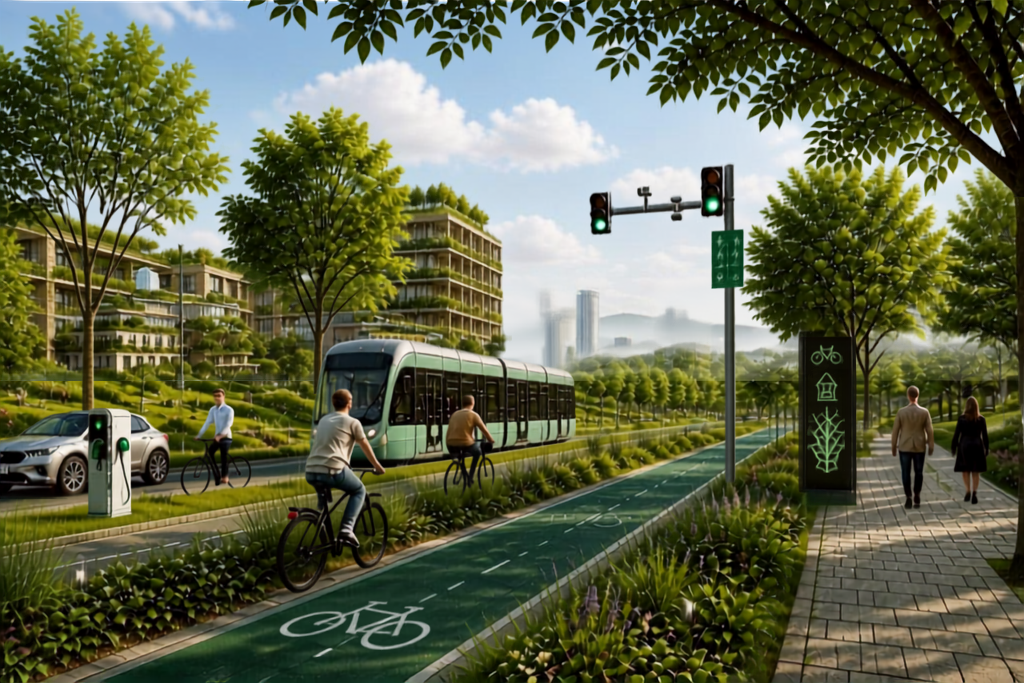
Air quality: trees play a fundamental and irreplaceable role in atmospheric purification by continuously absorbing a wide range of harmful pollutants and fine particulate matter. In doing so, they effectively offset residual emissions from urban traffic, serving as a strategic tool during the early and critical phases of the ecological transition toward low-impact transportation.
Urban heat mitigation: strategically planting street trees and developing interconnected green corridors significantly lowers perceived temperatures in dense urban areas. This transformation turns public spaces into cooler, more comfortable environments, making active and sustainable mobility safe and viable even during the hottest, most sultry summer months when such routes would otherwise be avoided.
Urban green spaces serve as critical ecological infrastructure for advanced stormwater management, naturally absorbing excess rainwater to significantly mitigate the threat of flash floods that frequently paralyze public transit and city traffic.
Prioritizing physical and mental well-being, the continuous expansion of scenic cycle lanes and pedestrian walkways—lined with vibrant trees and native flora—actively inspires residents to embrace active daily travel, delivering profound, lasting health benefits to the entire community.
Urban biodiversity thrives through the strategic design and dedicated maintenance of green corridors along major transportation networks. These living pathways rapidly evolve into genuine habitats and safe havens for diverse species, effectively bridging isolated parks and expansive green spaces across the dense urban landscape to significantly elevate the ecological health of the city.
A city that plans sustainable mobility without strategically thinking about urban greenery culpably leaves on the table a fundamental and essential part of the potential benefits for its inhabitants. Conversely, intelligently integrating urban reforestation into the daily design of bike lanes, public transport stops, and new pedestrian areas means actively building cities that are decidedly more livable, much cooler during the warm months, and significantly more resilient in the face of the pressing challenges posed by global climate change.
Successful reforestation and environmental regeneration are complex endeavors that demand the targeted, ongoing expertise of trained specialists. Simply planting trees at random is wholly inadequate. Instead, meticulous planning is required to determine how, when, where, and what to plant, as not all species are suited to every environment. This careful selection of tree and shrub varieties must account for the local climate, drought resistance, air quality benefits, exact geographical location, and available growing space.
Rome’s Eco Festival of Sustainable Mobility and Smart Cities serves as a vital platform to unite urban mobility, technological innovation, the circular economy, and neighborhood revitalization into a cohesive master plan. Foreste per Sempre contributes its deep expertise in urban forestry to this dialogue, driven by the belief that tomorrow’s most sustainable cities will successfully bridge the gap between asphalt and roots, engines and leaves, and cutting-edge technology and ecological renewal.
Ultimately, moving better also means breathing easier, reclaiming space to experience the city, and replacing harsh concrete with nature—a vision that is brought to life one tree at a time.
Further Reading:


Green Transit: How the Cities of the…

The Souls of Cabo Blanco Lola Pereira…

ABSTRACT Small persistent clearings in tropical forests…